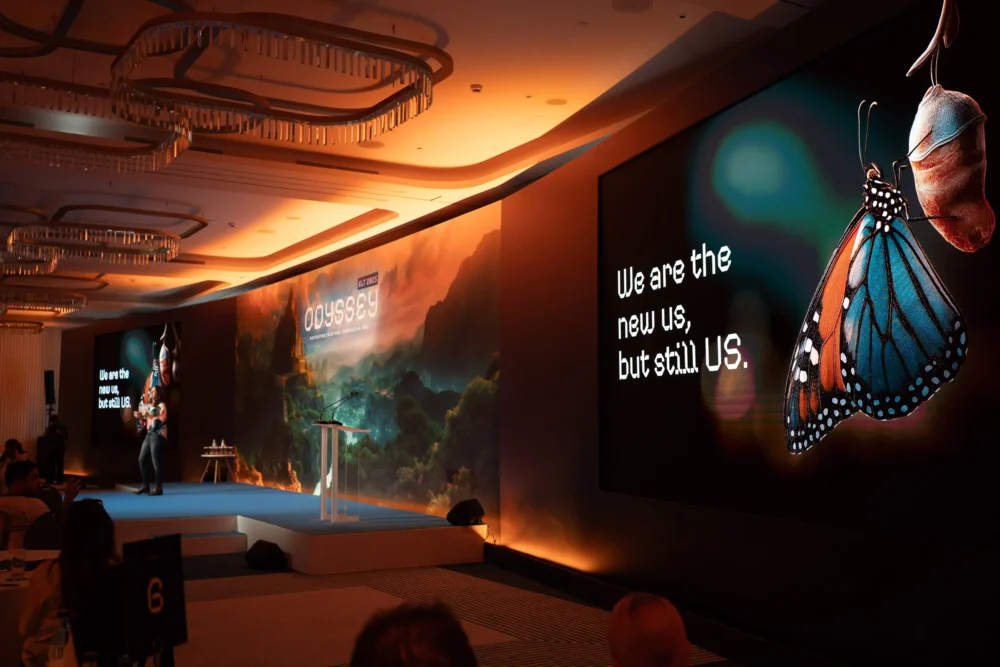
Most clients don’t come to an agency asking for ‘a theme’.
They come because the event has to do something that really matters, and it can’t afford to wobble. The leadership team needs to leave aligned, the message needs to be clear, and any change needs to feel compelling enough for people to actually buy into it.
And yet, when an event starts to feel messy, it’s rarely because the agenda itself is weak. It’s because everything is pulling in slightly different directions. Sessions make sense in isolation, but not as a whole. Stakeholders add ‘just one more thing’ and the content grows, the room feels busier, and the audience leaves with different versions of the story.
That’s when a theme stops being a creative nicety and becomes a practical tool.
A strong theme gives you one shared frame to hold the message. It helps people take in what they’re hearing—but more importantly, it helps them to carry it forwards.
A recent example:
Odyssey—turning three days into one story
We saw this first-hand on a three-day Executive Leadership team event for a global healthcare client in Athens. They’d run a similar event the year before, so expectations were already high. The brief was direct: raise the bar and make sure the message is unmissable.
The stakes were real. Big changes were coming, and if this group didn’t leave aligned, the organisation wouldn’t be either.
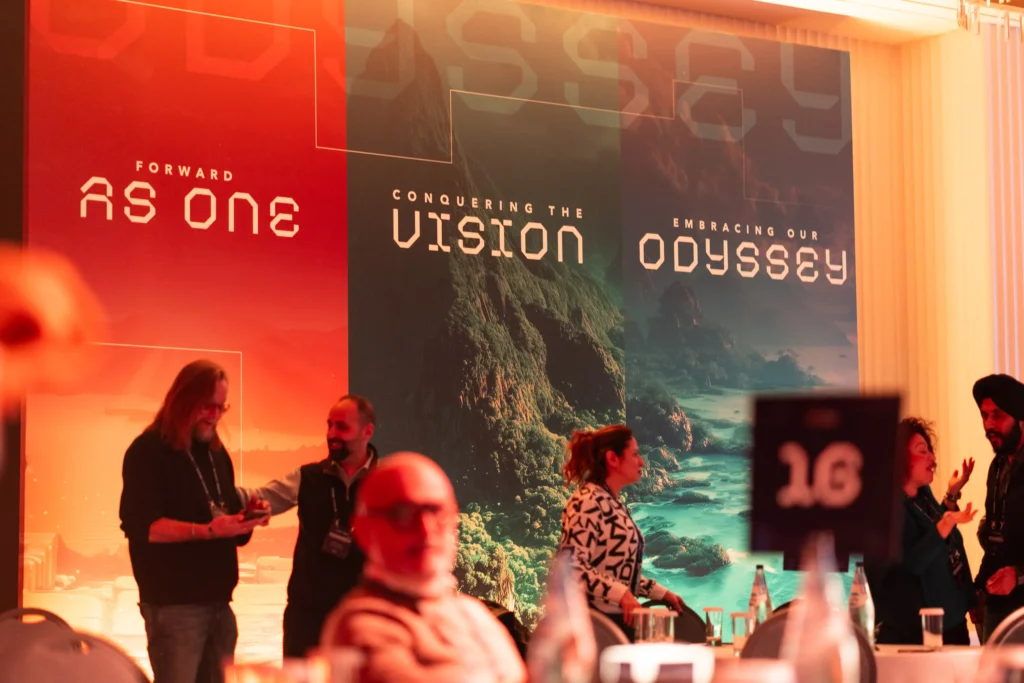
We landed on Odyssey. It emerged as a way of thinking about the event as a journey rather than a schedule—a narrative that could hold everything together across the three days. This structure became the story we would take them on.
- Day one: base camp (‘forward as one’)
- Day two: mountain climb (‘conquering the vision’)
- Day three: sailing beyond (‘embracing our odyssey’)
Here’s what the theme did:
It gave the whole experience coherence at scale. The narrative spine ensured everything worked in the same direction: design built environments, motion moved through them and copy charted the overall progression.
It gave the client a decision-making filter. When new content appeared, we had a way to test it. Does it serve the journey? Does it move us forward? That clarity saved hours of back-and-forth and stopped the event from sprawling.
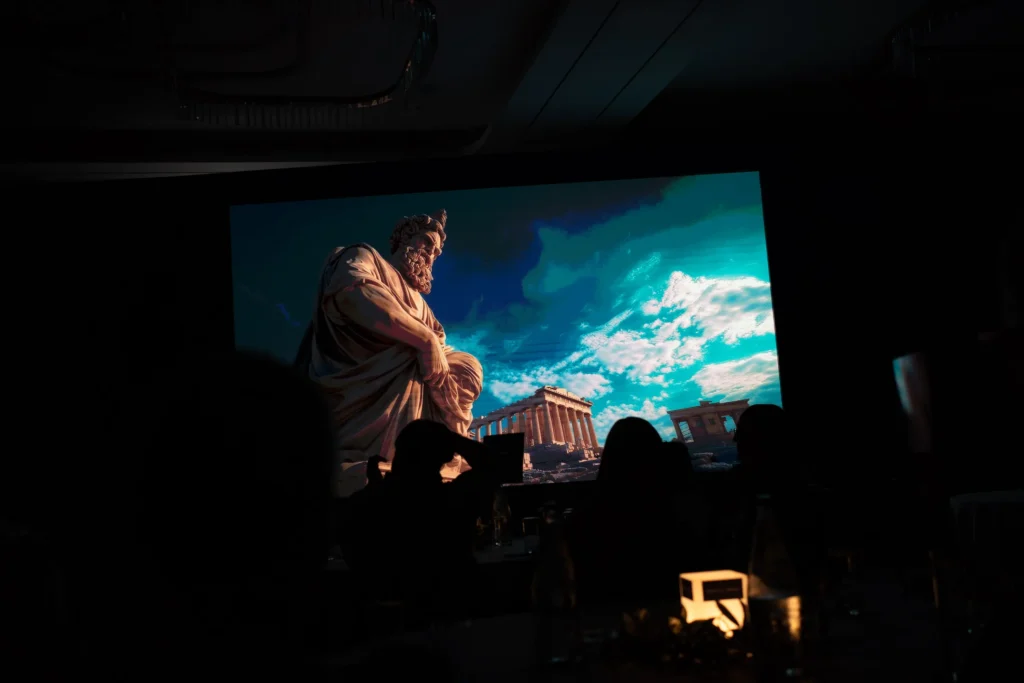
It also gave the audience a thread to follow. Leaders became ‘navigators’ and sessions became ‘waypoints’ in our journey. Transitions reinforced momentum instead of resetting the room. Films played like game-style cutscenes, so the content felt more like chapters than another presentation. Even the heavy stuff—finance, compliance, operational updates—landed differently because of the context. People knew where they were in the story and why it mattered.
What a good theme really buys you
If you’re planning a high-stakes event, a strong theme is about so much more than making your event feel more ‘creative’.
When we discover the right theme, a world of opportunity opens up. Because when we move through a story together and emotionally engage in the narrative, our brains release neurotransmitters that enhance our ability to recall memories. We don’t just remember the facts—we remember how we felt, where we were in the journey and what it meant for us. Which is exactly the difference between information and impact.
Telling the story together
We help you find the throughline early, shape it into a theme that can fully hold the message, then design the experience so every moment builds on it. That’s Transforming Creative into Reality—and how your audience leaves not just informed, but aligned.
 Related thoughts