There’s no questioning that AI has thrown a big old stick of dynamite right in the midst of the way work is created. For editorial teams, the subsequent content explosion has brought with it a lot of questions and, if we’re honest, a hearty side helping of existential angst.
It’s transformed workflows irrevocably, which isn’t surprising in industries where time is a currency and AI platforms can churn out thousands of words quicker than you can open a thesaurus.
But the thing about the word ‘transformation’ is that it’s neither inherently positive nor negative. At its core, it means a dynamic, fundamental change—which is definitely true. But with change comes—and this is a key word—nuance. Ironically, that’s something AI-generated copy tends to remove.
So here are some thoughts on the AI copy debate. Except instead of talking in statements, we’ve done our best to inject some nuance back into things. Because like most things in life, there are good bits and there are less-good bits. The key is staying informed and using your own (human) judgement to use the better bits to your project’s advantage.
AI can accelerate editorial workflows, but not always
It’s true that AI often speeds things up. (Yes, we’re aware that’s a statement, but hey, there’s that nuance for you.) In doing so, it’s also helped lower barriers to creating written content. But it doesn’t necessarily follow that it’s lowered the barriers to creating good written content.
That’s partly because good writing has never been about words alone. For a piece to truly speak to its reader, the experience has to feel seamless. There’s a compelling flow that takes you from one thought to the next in a way that feels intentional. And the way those thoughts are expressed—voice, tone and language—feels clear and authentic. You finish having digested a cohesive point that’s been delivered in an interesting way, whether you agree with what’s been posited or not.
Now, AI is undoubtedly helpful for some of that stuff. When you’re struck with a case of writer’s block, or are struggling to unpick a complex idea, it’s great for giving you a framework for your thinking and streamlining that brainstorming process.
Where it falls down, however, is when you ask it to generate the piece from scratch. More often than not, you’ll find the finished product circular in argument, peppered with dubious-sounding claims and written in a way that feels weirdly familiar. As the ultimate people pleaser, it tells you what you want to hear, not the objective truths that make your writing better.
As a result, it’s not uncommon to find yourself spending just as much time editing a piece to make it feel ‘human’—and fact-checking that those claims are actually legit—than if you’d just written it yourself in the first place. Which brings us on to our next point.
Navigating the sea of sameness
Noticed how everything’s starting to sound weirdly familiar? Us too. We’ve all got stuck into the em dash debate and found ourselves noticing the repetitive use of certain buzzwords and sentence structures. (We’re talking about you, rule of three; and you, ‘It’s not X, it’s Y.’ We’ve also never been asked to ‘dive’ into anything quite so much… call us Tom Daley.)
Jokes aside, it’s no coincidence that there’s been a marked homogenisation of the tone and style of vast swathes of the comms we consume in recent years. It’s also a bit of a Catch-22: as more AI-generated content gets published, the more we ingest—and the more we subconsciously begin to emulate its style and turns of phrase. It’s not just that we’re using more AI, it’s that we’re starting to imitate the imitator. See what we did there.
That’s why one thing in particular has become more important than ever: sounding like an actual human being with a tangible personality who knows the people they’re speaking to.
Authenticity as the gold standard
What hasn’t changed is that people generally still don’t like to be marketed to. People are also developing a distinct aversion to copy that’s obviously AI-generated—something often referred to as ‘AI slop fatigue’.
We see it as a relationship thing. Like all good partnerships, the bond between brand and customer is built on trust. So why should your customers trust what you’re saying if it’s clear you haven’t taken the time to make sure it’s something that actually speaks to them?
As humans, we have something AI doesn’t, and that’s direct experience of living in the real world. As marketers, those human, real-world conversations with our customers translate to insights—language, humour, nuance—that allow us to resonate with the specificpeople we’re talking to. AI struggles to do that.
When used at its most effective, AI is an eager-to-please assistant. And there’s no shame in letting it help you, even if it makes a rubbish cup of tea. But when you let it take over completely, the quality of your message suffers because the personality gets stripped right out. That’s a surefire way to make sure your message blends in with every other that’s been generated in the same way.
Looking to the future
Change is the only constant, and AI isn’t going anywhere. Not that we’d necessarily want it to; when used in the right way, it’s genuinely helpful.
But for an editorial project to be successful, its team need to know how to work with it. It’s a partnership, but not an equally weighted one—the fact remains that no algorithm can fully replace the intricacies and peculiarities of the human mind.
Ultimately, publishing AI-generated content without proper editorial oversight is like trusting a toddler to decorate your house. Unlikely to end well, and you’ll be the one left staring at the consequences.
And there’s an analogy no AI platform could come up with.
It’s not what you say, but how you say it.
Let’s be honest, congresses, conferences and similar events are about so much more than “next slide please”. At heart, they’re about three things: sharing knowledge, building networks and creating a sense of community. Done right, these elements don’t just coexist—they work in synergy.
But here’s the catch: none of that good stuff happens if your audience has checked out before you’ve even got to the keynote. In an age where attention is a currency that’s increasingly hard to hold on to, how you deliver your content matters more than ever.
So, how do you make it land?
You get creative.
A strong, cohesive theme is the spine of your event. It gives structure and pulls everything together into one clear and memorable entity. Without it, you’re left with a series of disconnected sessions, each doing their own thing, jostling for attention and making the day feel disjointed.
You want your audience to connect with the bigger picture—each session should add a brushstroke to the same canvas, not feel like it belongs in a different painting.
Nobody enjoys being talked at; it’s way more fun to be part of the action. Plan your agenda around segments. The punchier, more varied and full of surprise they are, the better.
And don’t forget that narrative thread. People are far more likely to get stuck in when they understand the why behind what they’re being asked to do. Active participants > passive listeners. Create partnerships.

Brutal as it sounds, people forget most of what they hear at conferences. Information retention during passive formats is low—like, 10–25% of key messages from a full-day event low—and even then, that’s only if the ideas are clearly structured and reinforced.
Research also suggests that retention starts to nosedive after around 45–60 minutes of high-density content. So, strip it back! Focus on a few big ideas and find ways to reinforce them. Schedule breaks, let your audience get hands-on and watch their retention skyrocket.
Time for some science. Humour isn’t just about fleeting laughter—dopamine is proven to boost memory. A healthy dose of fun turbocharges our engagement with the content and increases the staying power of the message behind it.
It doesn’t have to be silly; it just has to be human. Whether it’s something witty or simply moment that makes people smile, it all works. Make your audience feel something. Ideally, joy.
Congresses bring together all sorts. Different people turn up looking for different things, which is yet another reason why how you deliver your message matters as much as what you say.
Shared cultural formats are a great way of connecting with a broad and varied crowd. Could your message be worked into a fun and relatable format, like a gameshow or chat show? Make it bite-sized and impossible to skip past—when the delivery feels fresh and exciting, people are more likely to tune in.
The crux of it is: you can’t expect people to listen if you’re not speaking in an interesting way. Your audience’s experience has to be top of the bill, even if it means having to rethink your delivery.
You can’t rely on just getting attention; you have to go out of your way to earn it. That means not doing the same old stuff that everyone else is. Instead of just presenting your message, give it production value. That way, your audience will still be thinking about it months down the line.
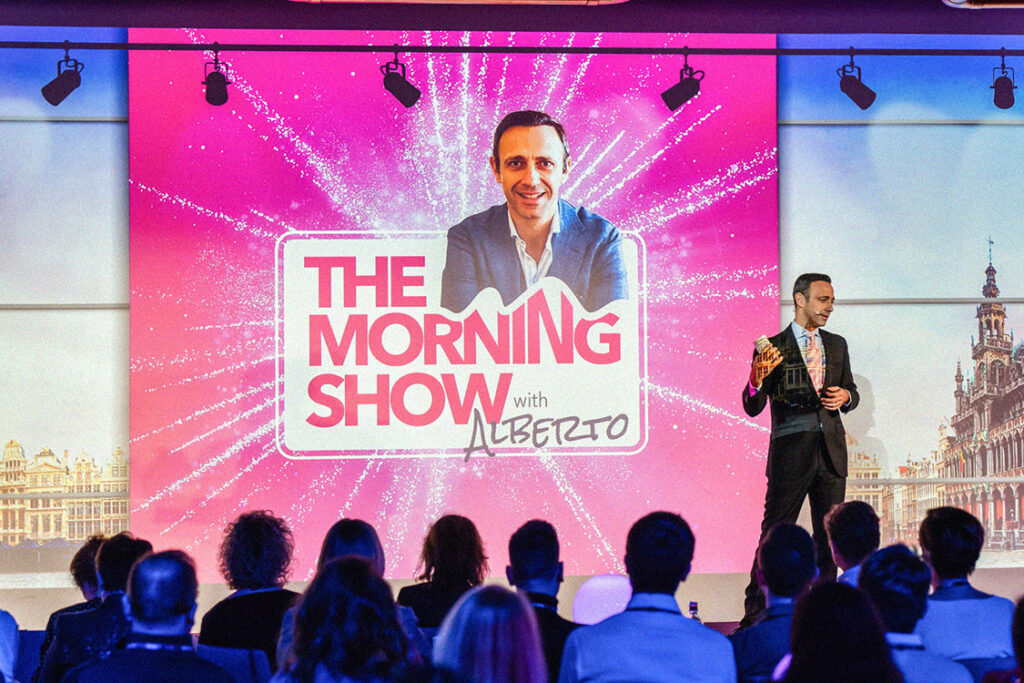
When a client asked us to dial up the energy and bring a sense of cohesion to their section of a wider meeting, we knew we had to give them something out of the ordinary.
Inspired by daytime TV, we created The Morning Show—a peppy and entertaining format complete with its own branding, credits, theme music and stings. We even had our ‘stage manager’ hype up the studio audience to get them fully on board with the concept before the cameras started rolling.
Instead of sessions, we ran segments which our live host pulled together into one dynamic package. Each segment, while unmistakably on theme, delivered something different:
The result? Rave reviews, enthusiastic engagement and a client who’s already thinking about The Morning Show episode 2.
Ready to make your next conference unmissable? Let’s chat engagement.