Great creative rarely begins with a great idea. It begins with a better question.
At Outlook Creative, we’ve never believed that inspiration is the hard part. Discipline is. Knowing when creative can do the heavy lifting versus when it just sounds good in a friendly room. Knowing when to push further and when to stop tinkering. Knowing the difference between interesting and right. Strategy and rationale aren’t just as important as the creative—they’re critical elements, baked into everything we do.
Here’s how we get there.
1. Diagnose before you prescribe
We start by interrogating the brief, not executing it. What’s the real problem underneath the stated one? Who and what needs to be moved and from where to where? The obvious answer usually has a better one hiding just behind it. Great creative finds exceptional solutions, so you’d better ask the right questions up front.
2. Discover what’s actually interesting
Every project has a detail, a tension or an angle that makes the whole thing suddenly click. It’s rarely on page one of the brief. Our job is to find it, recognise it for what it is and resist the temptation to sand off its edges to make it feel safer.
3. Pressure-test. Repeat
We don’t fall in love with concepts too early. We push them, argue with them and ask the questions that might break them. The ideas that survive aren’t just clever. They’re durable. And they have an outcome that can be measured.
4. Build the system, tell the whole story
A great idea has to work everywhere: not just in the showpiece execution, but in every format, channel and context it will actually live in. We design creative that holds together as a system, consistent enough to be recognisable and flexible enough to travel.
5. Craft it until it earns attention
Execution is where most ideas are won or lost. The right word over the almost-right word. The visual that clarifies rather than decorates. The detail that makes someone stop and look twice. This is where rigour and imagination have to occupy the same space, and where we do our best work.
6. Ship it. Stay with it. Measure it.
Making it isn’t finishing it. We stay with the work from delivery and care what happens after it lands. Did it move the right people? Did it do the job? Do we need to adjust? Great creative isn’t just made well—it’s followed through on.
In the end, a creative process only matters if it changes something. Whether that’s what people understand, what they feel or what they do next. That’s why discipline sits at the centre of everything we make. It’s how we turn ambition into structure or ideas into systems and, finally, execution into impact.
At Outlook Creative, we’re not interested in work that simply looks finished; we’re interested in work that performs in the real world and holds its shape under pressure. We want work to earn its place every single time it’s seen. Because great creative isn’t defined at the point of launch, but in everything it goes on to change afterwards.
Every piece of work has a story behind it. Not just what was made, but how and why it came to be. So we asked our Creative Director, Pete Michels, to share a different kind of perspective—one that steps back from the finished work and into the thinking behind it, offering an insightful glimpse behind the curtain of creativity.
Recently we tried something a little different.
Nothing revolutionary—pretty simple actually. But after going through it, I don’t think we can live without it.
Creative work has a beautifully strange rhythm. You spend an inconsistent amount of time thinking about something. Exploring it. Questioning it. Pushing it forward. Questioning it again.
Then eventually you commit.
And eventually you let it go.
One day it’s ‘finished’. The files are sent. The project moves on. And the work begins to take on a life of its own.
(They grow up so fast.)
And like most things we release into the world, we rarely sit down with it again.
Most designers don’t get the chance to stop and talk about the work once it’s done. Of course there are conversations during the process. Rationales. Check-ins. Presentations.
But that’s still the process.
What’s often missing is the story after the work has been set free.
The hesitations.
The instincts.
The micro-decisions that quietly changed everything.
So, we asked the designers to bring the work back.
Client work. Personal work. The things they’re proud of. Sometimes the things they’re still figuring out.
And then we sit down and talk. Just three of us.
Over the past few weeks each designer has been sitting down with Andy, our therapeutically calm Art Director, and myself (nothing therapeutic about me) to share what we’ve been calling a ‘personal lookbook’.
It’s not a presentation.
It’s not a critique session.
When it works well, it’s closer to a one-sided conversation.
This is their time to talk about the work. We mostly listen. Occasionally scribble something down. Andy radiates a calming presence.
Creative wellness at its finest.
Designers bring together projects and personal work they’re proud of, and sometimes work they’re still processing.
And they talk.
The thinking behind it.
The decisions that shaped it.
The instincts that pushed it one direction instead of another.
They’re using a muscle that, for many designers, doesn’t get exercised often enough.
The muscle of explaining how their creative mind actually works.
These sessions are intentionally small. Just three people in the room.
That intimacy matters.
Sometimes the conversations get unexpectedly personal.
Because creativity, whether we admit it or not, is something we all take a little personally.
Finished design can feel inevitable.
Once something exists in the world, it looks like it was always meant to be that way.
But anyone who has made something knows the truth is usually much messier.
There are moments of uncertainty.
Ideas that almost worked.
Decisions made on instinct, skill, taste and confidence.
Details that need unpacking. Debate. Occasionally, a high-five.
The lookbook sessions open the doors on all of this.
And what emerges isn’t just a collection of projects.
It’s something much more interesting.
A map of how a creative brain works.
Something interesting happens when designers talk about their work like this.
They start by sharing what they’re proud of. The projects that meant something to them. The ideas that pushed a little further. The details that quietly hold everything together.
And often it’s not the projects you’d expect.
But as the conversation unfolds, something shifts.
Not toward critique. Toward understanding.
Why this idea felt right.
Why that decision mattered.
Why certain instincts led the work in a particular direction.
What emerges isn’t a defence of the work.
It’s clarity.
Because real creative confidence doesn’t come from believing you’re always right.
It comes from understanding why you made the decisions you did, and being able to stand behind them.
Here’s the part we didn’t fully anticipate.
Andy and I learn just as much in these sessions as the designers do.
Sometimes we discover strengths we hadn’t fully seen yet.
An interest we haven’t tapped into.
An instinct that deserves more room.
A perspective we should be leaning into far more often.
You start to realise that reviewing the work isn’t really the point.
Understanding the person behind the work is.
These conversations help us see not just what someone has made, but the kind of designer they’re becoming.
Design, after all, is a profession built on judgement.
And judgement only develops through experience, reflection and conversation.
(take a few of them, actually)
In an industry that moves quickly, taking time to step back and talk about the work can feel almost radical.
There’s always another brief.
Another deadline.
Another project waiting to begin.
But pausing to reflect, even briefly, reminds us that creative growth doesn’t just happen through making more work.
Sometimes it happens through understanding the work we’ve already made.
Because the fastest way to grow as a designer is to understand how you already think.
And occasionally, through laughing at the decisions we thought were brilliant at the time.
Great studios talk about the work.
Great designers talk about why the work exists at all.
The lookbook sessions are quiet conversations.
No presentations.
No audience.
No performance.
Just designers reflecting on the work that matters to them, and the thinking behind it.
And in those conversations, something important becomes visible.
Not just what someone has made.
But the designer they’re becoming.
And, hopefully, the studio we’re becoming together.
Recently, our Joint MD, Adam Sherlock, teamed up with our Creative Director, Peter Michels, and Art Director, Andy Upton, to explore how AI is pushing us to be more human, more analogue, and more creatively unhinged (in a good way).
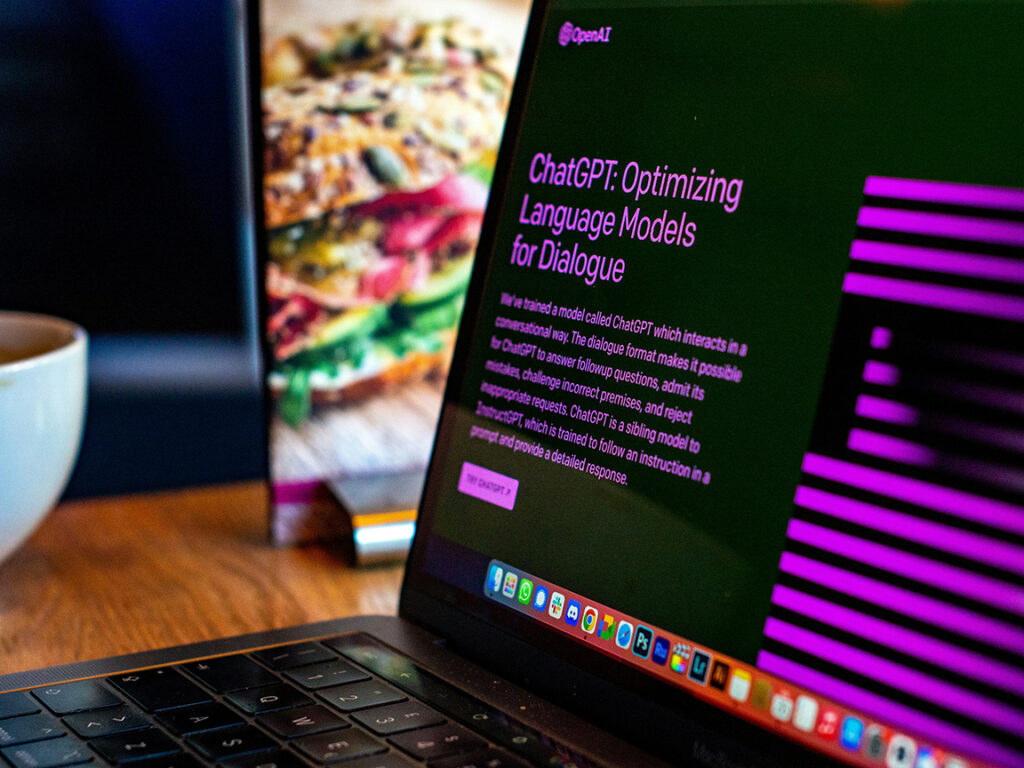
There’s been a flurry of conversations recently about whether or not AI is creative. Is it going to wipe out the creative community in one Spielbergian zap? Should you finally open that doggie bakery your neighbourhood desperately needs?
Maybe we’re looking at this all wrong. Maybe we’re not asking the right questions.
It’s not about whether AI is creative. It’s about how AI is affecting our own creativity and our creative futures—positively. This is about us after all.
I’d like to approach this discussion of AI in the design space from a different perspective: what if AI actually sets us free creatively?
I sat down with our Art Director, Andy Upton, to talk about how AI isn’t here to steal our creative souls—it might just let us fly. If we play this right, if we own this moment, AI could be our ticket to being more human, more analog, and more unhinged (in a good way) with our ideas. At least as artists. We could be quicker, stronger, and capable of grabbing the undiscovered.
Hear me out.
“The reality of AI is that it’s a simulation of creativity,” Andy said after a sip. “It’s taking what it’s learned and piecing it together. So, is it creative? Not in the truest sense of human creativity.”
AI isn’t out here dreaming up the next postmodern masterpiece. It’s pulling from what already exists, remixing it like a DJ with unlimited samples. It can assist, but it can’t originate.
That’s where we come in.
The wild originality. The gut feelings. The moments where you think, this is either genius or completely certifiable. The subjective messiness of creativity—that’s human.
For the longest time, beyond the artistic spark, being a designer meant mastering tools—whether it was charcoal and ink, scissors and glue, or Adobe. But now?
Still true. But AI shifts the game.
“AI takes away the more skill-based element of knowing how to do something and pushes you more into the idea side of things,” Andy pointed out. And that’s liberating.
Being creative for creativity’s sake. Digging into the dusty corners of your heart and soul. AI lets us actually open up areas of our brain that haven’t raised their hands in a while.
Instead of grinding for hours in soul-crushing stock libraries, a well-trained prompt lets us generate those elements ourselves—and they’re ours. There’s even a sense of pride in that.
Think about the exploration on all levels—concepting, inspiration, building elements, even proofing. It’s not about losing craft—it’s about separating craft from creativity.
At this point, it’s critical to realise that AI replaces nothing whole. It’s still a skill. A tool. And like any tool, it needs the piloting of a craftsman. Even then, it can’t do everything—it’s just one coat of paint.
I have cameras that haven’t smelled silver in decades, records hibernating in the “B’s” that haven’t hit the mat since consistent seasons (I haven’t forgotten about you, Bangles), and ornate plates that house a dozen oysters perfectly—that have been used… never.
None of these things are going anywhere.
I’m not a hoarder.
There’s a visceral connection—a memory of that emotion. These are crumbs of our creative therapy.
What I’m getting at is that AI is actually making a lot of us less digital. It’s pushing us back into the analogue world, giving us more time to experience the things that make us who we are.
We’ve been freed up to get our hands dirty again. Get everything dirty.
“I’ve seen more designers excited about getting physical with their work—painting, collaging, using their hands—because AI can’t replicate that experience,” Andy said. “There’s something about physically pushing paint around that you don’t get from just prompting MidJourney.”
AI is pushing us back toward our roots as artists and storytellers. The things that feel raw, messy, and personal—AI can’t touch those. And that’s exactly why they matter more than ever.
That’s the paradox.
AI gives us speed, efficiency, and endless iterations, but it also reminds us why human touch matters. It helps us focus on the feeling behind the work, rather than just the mechanics.
And that’s not to say using AI isn’t a part of this analogue evolution. Andy’s personal work proves it. Finding the right image or pattern to “cut out” for his compositions has dropped the needle on the next chapter of his visual storytelling.
The problem isn’t AI itself—it’s the idea of AI. It’s the fear of AI.
But let’s be real: people once thought Photoshop was cheating. Now? It’s just part of the process.
“It’s just expected. AI as a term will probably disappear and just become part of most of our tools. It’s already happening,” I told Andy.
“It’s important to remember it’s just part of the process, not the process,” Andy said. “Like Photoshop helped you get where you were going, AI does the same—but you need to know when and how to use it. That’s a skill on its own.”
Narratives always change over time.
AI isn’t a supervillain. It’s not the main character, either. It’s that background extra holding a boom mic, making sure we sound good while we do our thing.
It’s here to help us create and evolve. To make us wilder, more unpredictable, and push storytelling beyond the expected seven storylines.
I’m not treating it like a threat.
I’m treating it like the overqualified, unpaid intern who still has a lot to learn.
And I haven’t had to talk to HR in weeks.
It might even bring you a taco someday while you’re busy changing the creative world.
And take comfort in this: if AI were really here to replace us, it would have come up with a better closing line than this.
So, what do you think? Does AI make us more creative or am I off base? Is it an overqualified intern, or are we actually training it? Drop your thoughts…somewhere?
Feeling inspired? See how we can free your mind on your next project. Get in touch to see how we can collaborate.
The funny thing about the word “relentless” is that you don’t want to mess around with it. It can carry negative connotations—”the Carolina Reaper seed was relentless when I ‘accidentally’ flicked it in my eye on a dare.”
There’s an intensity we felt was necessary when we discussed our approach to creativity. “Let’s get serious,” we said. “Let’s get disruptive” (a grossly played-out term, we agreed). Let’s communicate that we are passionate and a bit inflexible when it comes to revolutionary creativity. You know what? We are relentless when it comes to our creative. Bold? Yep. Honest? Always. Scary? A little. But we if aren’t pushing and scaring ourselves regularly, we are doing it wrong.
“Creative,” on the other hand, truly belongs to everyone. Sure, the word is knocked around a lot, and some might argue tossed around too much, diluting its very nature. But I don’t believe that to be true. I believe it’s fair to say that everybody is a bit creative. It takes creativity to run a business, mow a lawn, deliver the mail, decode my daughter’s borderline criminal algebra, navigate the Northern Line, tie a shoe. It’s certainly not reserved for “creatives.” We’ve all heard “I’m not a creative person” countless times. People often say it if they feel they are surrounded by “creatives.” It’s a disclaimer. It’s a proclamation. It’s malarkey.
So, what does being relentlessly creative mean to us as an agency?
Everything.
Strong creativity is our driving force. I wouldn’t be writing this, or even be here, if it wasn’t for our approach to creativity. We use it to breathe life into everything we do, across all touchpoints. It’s this WHOLE-AGENCY APPROACH that sets us apart. Think about that for a sec. Everyone. A select group of highly skilled people, all motivated by a common goal, all using their specialities to develop a better way of doing something, looking at the world, bringing your band experience to centre stage.
We’ve delved deeply into our core motivations (they’re here, [link] by the way), and our approach to creativity is kinda like crafting the perfect pizza from scratch. Meticulously selecting the freshest ingredients, balancing flavours, and considering the preferences of everyone who folds a slice and has a bite. It’s beyond what we create; it’s where we transport you. Mmm.
Sure, that metaphor may stretch thin in places, but you get the idea. It’s a collaborative effort—a mindset we share and strategically use to constantly strive for improvement. It’s what fuels us, sparks innovation, binds us together, and we don’t compromise.
You can be relentless, and you can be creative, but being relentlessly creative is something entirely different. We will continue to throw the word “creative” around, whether it’s overused or not, and so should you.