There’s no questioning that AI has thrown a big old stick of dynamite right in the midst of the way work is created. For editorial teams, the subsequent content explosion has brought with it a lot of questions and, if we’re honest, a hearty side helping of existential angst.
It’s transformed workflows irrevocably, which isn’t surprising in industries where time is a currency and AI platforms can churn out thousands of words quicker than you can open a thesaurus.
But the thing about the word ‘transformation’ is that it’s neither inherently positive nor negative. At its core, it means a dynamic, fundamental change—which is definitely true. But with change comes—and this is a key word—nuance. Ironically, that’s something AI-generated copy tends to remove.
So here are some thoughts on the AI copy debate. Except instead of talking in statements, we’ve done our best to inject some nuance back into things. Because like most things in life, there are good bits and there are less-good bits. The key is staying informed and using your own (human) judgement to use the better bits to your project’s advantage.
AI can accelerate editorial workflows, but not always
It’s true that AI often speeds things up. (Yes, we’re aware that’s a statement, but hey, there’s that nuance for you.) In doing so, it’s also helped lower barriers to creating written content. But it doesn’t necessarily follow that it’s lowered the barriers to creating good written content.
That’s partly because good writing has never been about words alone. For a piece to truly speak to its reader, the experience has to feel seamless. There’s a compelling flow that takes you from one thought to the next in a way that feels intentional. And the way those thoughts are expressed—voice, tone and language—feels clear and authentic. You finish having digested a cohesive point that’s been delivered in an interesting way, whether you agree with what’s been posited or not.
Now, AI is undoubtedly helpful for some of that stuff. When you’re struck with a case of writer’s block, or are struggling to unpick a complex idea, it’s great for giving you a framework for your thinking and streamlining that brainstorming process.
Where it falls down, however, is when you ask it to generate the piece from scratch. More often than not, you’ll find the finished product circular in argument, peppered with dubious-sounding claims and written in a way that feels weirdly familiar. As the ultimate people pleaser, it tells you what you want to hear, not the objective truths that make your writing better.
As a result, it’s not uncommon to find yourself spending just as much time editing a piece to make it feel ‘human’—and fact-checking that those claims are actually legit—than if you’d just written it yourself in the first place. Which brings us on to our next point.
Navigating the sea of sameness
Noticed how everything’s starting to sound weirdly familiar? Us too. We’ve all got stuck into the em dash debate and found ourselves noticing the repetitive use of certain buzzwords and sentence structures. (We’re talking about you, rule of three; and you, ‘It’s not X, it’s Y.’ We’ve also never been asked to ‘dive’ into anything quite so much… call us Tom Daley.)
Jokes aside, it’s no coincidence that there’s been a marked homogenisation of the tone and style of vast swathes of the comms we consume in recent years. It’s also a bit of a Catch-22: as more AI-generated content gets published, the more we ingest—and the more we subconsciously begin to emulate its style and turns of phrase. It’s not just that we’re using more AI, it’s that we’re starting to imitate the imitator. See what we did there.
That’s why one thing in particular has become more important than ever: sounding like an actual human being with a tangible personality who knows the people they’re speaking to.
Authenticity as the gold standard
What hasn’t changed is that people generally still don’t like to be marketed to. People are also developing a distinct aversion to copy that’s obviously AI-generated—something often referred to as ‘AI slop fatigue’.
We see it as a relationship thing. Like all good partnerships, the bond between brand and customer is built on trust. So why should your customers trust what you’re saying if it’s clear you haven’t taken the time to make sure it’s something that actually speaks to them?
As humans, we have something AI doesn’t, and that’s direct experience of living in the real world. As marketers, those human, real-world conversations with our customers translate to insights—language, humour, nuance—that allow us to resonate with the specificpeople we’re talking to. AI struggles to do that.
When used at its most effective, AI is an eager-to-please assistant. And there’s no shame in letting it help you, even if it makes a rubbish cup of tea. But when you let it take over completely, the quality of your message suffers because the personality gets stripped right out. That’s a surefire way to make sure your message blends in with every other that’s been generated in the same way.
Looking to the future
Change is the only constant, and AI isn’t going anywhere. Not that we’d necessarily want it to; when used in the right way, it’s genuinely helpful.
But for an editorial project to be successful, its team need to know how to work with it. It’s a partnership, but not an equally weighted one—the fact remains that no algorithm can fully replace the intricacies and peculiarities of the human mind.
Ultimately, publishing AI-generated content without proper editorial oversight is like trusting a toddler to decorate your house. Unlikely to end well, and you’ll be the one left staring at the consequences.
And there’s an analogy no AI platform could come up with.
Great creative rarely begins with a great idea. It begins with a better question.
At Outlook Creative, we’ve never believed that inspiration is the hard part. Discipline is. Knowing when creative can do the heavy lifting versus when it just sounds good in a friendly room. Knowing when to push further and when to stop tinkering. Knowing the difference between interesting and right. Strategy and rationale aren’t just as important as the creative—they’re critical elements, baked into everything we do.
Here’s how we get there.
1. Diagnose before you prescribe
We start by interrogating the brief, not executing it. What’s the real problem underneath the stated one? Who and what needs to be moved and from where to where? The obvious answer usually has a better one hiding just behind it. Great creative finds exceptional solutions, so you’d better ask the right questions up front.
2. Discover what’s actually interesting
Every project has a detail, a tension or an angle that makes the whole thing suddenly click. It’s rarely on page one of the brief. Our job is to find it, recognise it for what it is and resist the temptation to sand off its edges to make it feel safer.
3. Pressure-test. Repeat
We don’t fall in love with concepts too early. We push them, argue with them and ask the questions that might break them. The ideas that survive aren’t just clever. They’re durable. And they have an outcome that can be measured.
4. Build the system, tell the whole story
A great idea has to work everywhere: not just in the showpiece execution, but in every format, channel and context it will actually live in. We design creative that holds together as a system, consistent enough to be recognisable and flexible enough to travel.
5. Craft it until it earns attention
Execution is where most ideas are won or lost. The right word over the almost-right word. The visual that clarifies rather than decorates. The detail that makes someone stop and look twice. This is where rigour and imagination have to occupy the same space, and where we do our best work.
6. Ship it. Stay with it. Measure it.
Making it isn’t finishing it. We stay with the work from delivery and care what happens after it lands. Did it move the right people? Did it do the job? Do we need to adjust? Great creative isn’t just made well—it’s followed through on.
In the end, a creative process only matters if it changes something. Whether that’s what people understand, what they feel or what they do next. That’s why discipline sits at the centre of everything we make. It’s how we turn ambition into structure or ideas into systems and, finally, execution into impact.
At Outlook Creative, we’re not interested in work that simply looks finished; we’re interested in work that performs in the real world and holds its shape under pressure. We want work to earn its place every single time it’s seen. Because great creative isn’t defined at the point of launch, but in everything it goes on to change afterwards.
For twenty years, a global medtech leader has trusted us with their highest-profile events.
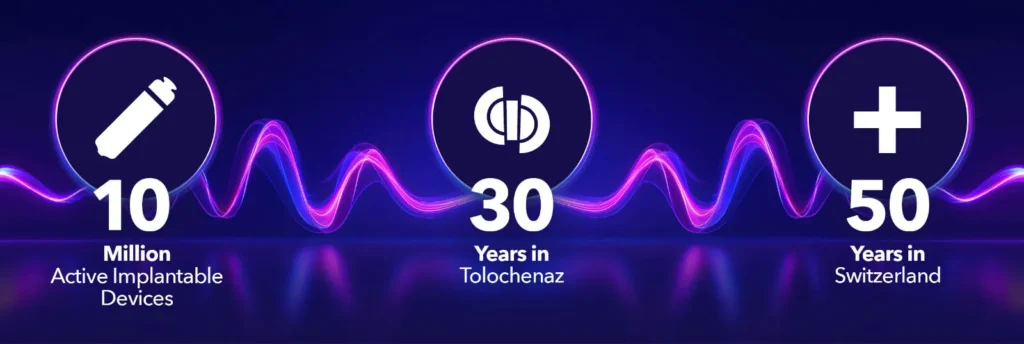
So when they approached us to help launch their 2026 milestone celebrations, we knew that it would be a standout project. The year marks three major milestones, each representing decades of innovation, growth and impact in healthcare:
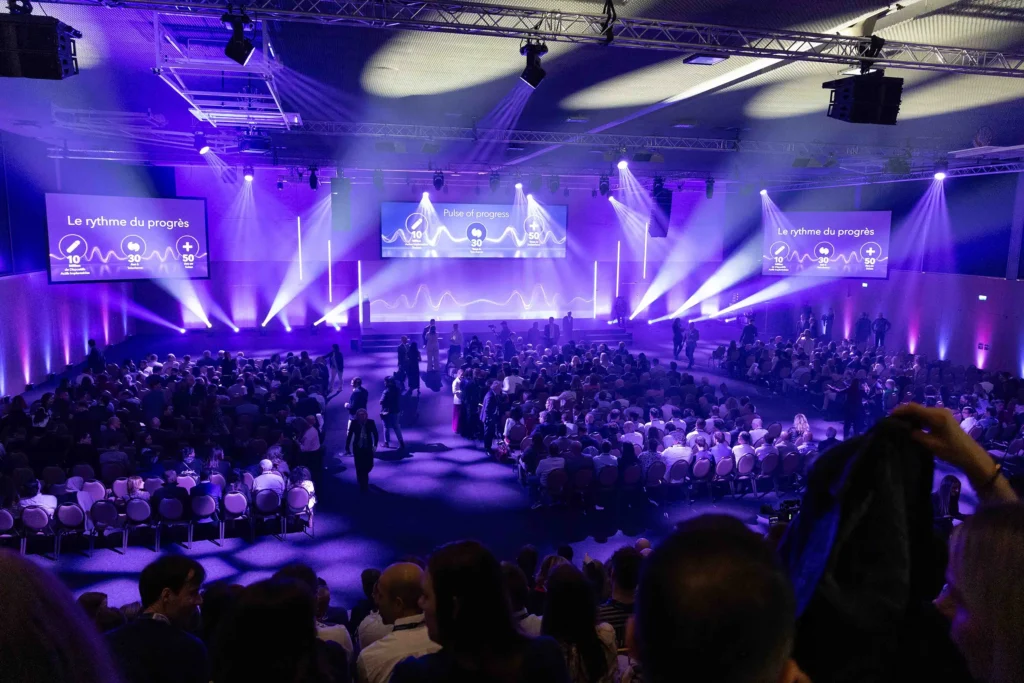
To bring those moments together, we looked to create an identity for a two-day celebration involving more than 800 employees alongside senior and executive leadership. The original brief sounded simple: one visual for one event. But as we explored the project, it became clear that this was something far bigger. A milestone year that demanded an identity capable of carrying the story.
Finding the pulse
These anniversaries were about more than numbers. They needed to resonate with the people behind them. They were a powerful reminder that lives have been changed and clinicians and caregivers have been supported, all made possible by their employees’ hard work and innovation to shape the future of healthcare.
So with the stakes this high, the creative process had to start with the right question: what does this moment actually represent?
We came up with the idea: the Pulse of Progress.
A pulse is a simple but powerful signal of life, capturing movement and momentum. And progress, whether in healthcare, technology or patient outcomes, is rarely linear. The concept felt right immediately.
Collaborative creative
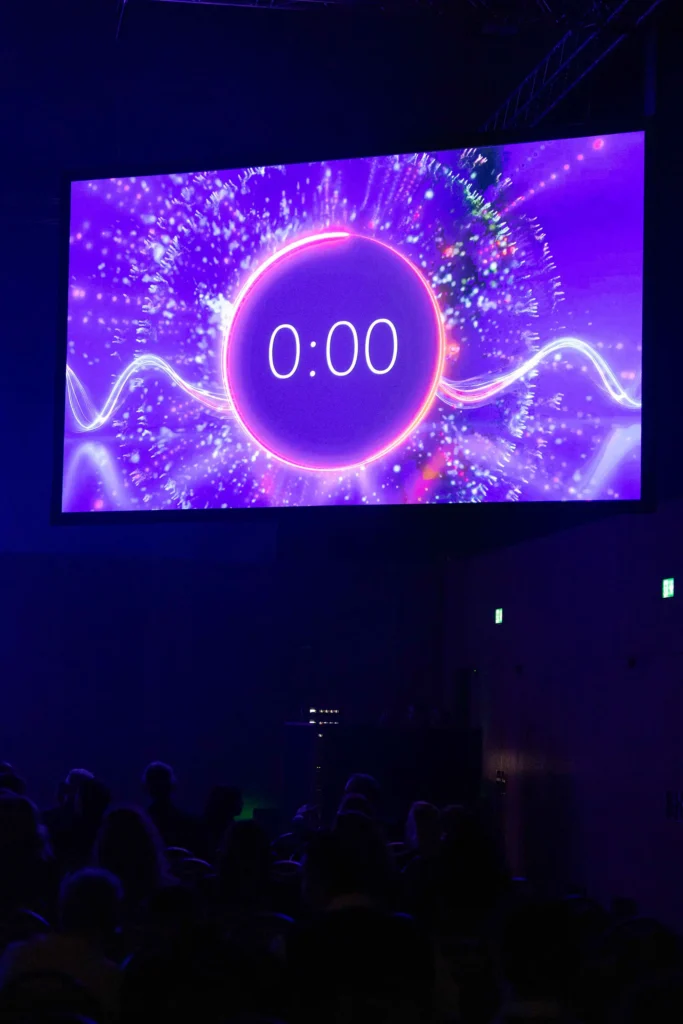
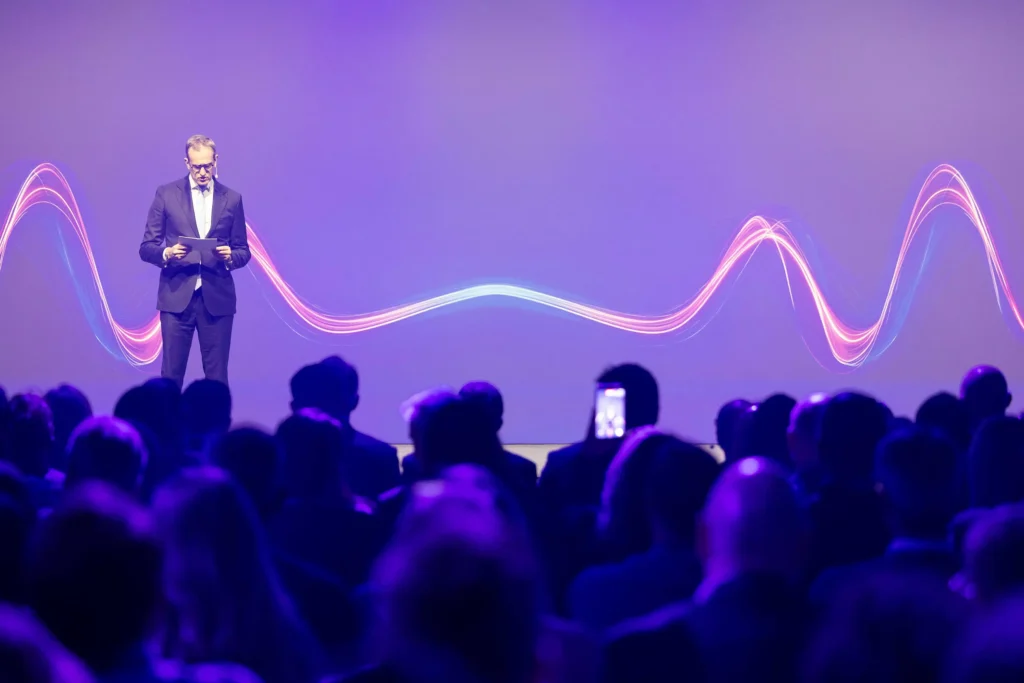
To bring it to life visually, the team developed a distinctive ‘wave’ identity. This took the form of a rhythmic pulse that could move across various formats, screens and spaces. This visual language that felt both dynamic and meaningful, as well as connected the client’s role at the heart of healthcare.
Projects like this only work when different disciplines work in harmony: creative direction, art direction, design, copywriting and moving image all came together holistically, ensuring every piece of the campaign told the same story.

Bringing the story to life
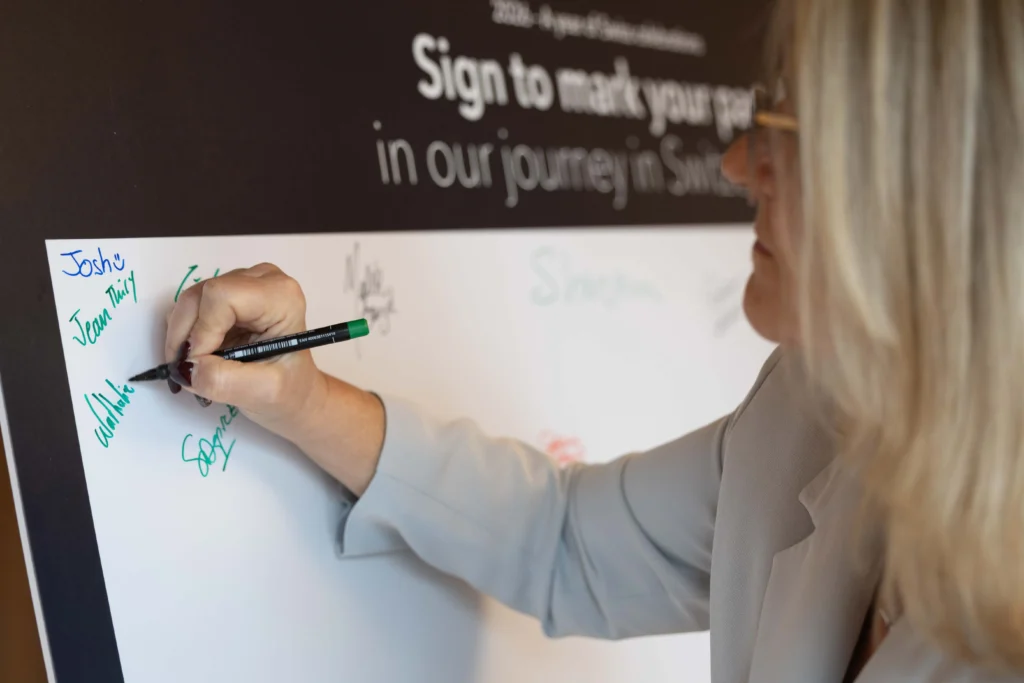
Once the identity was established, the campaign quickly expanded across multiple formats. The team designed and produced a wide range of materials, including presentations, event branding, environmental graphics and video content.
In the weeks leading up to the celebrations, our video team spent multiple filming days capturing additional content to support the narrative. One of the most powerful moments came in Bern, where our crew documented the implantation of a landmark implantable device at one of the country’s leading hospitals. A milestone that brought the scale of the achievement into sharp focus.
The two-day event itself marked just the beginning. Even weeks after the launch, internal teams continued to reference the work, and external audiences noticed its reach. Short-form social edits, long-form storytelling and internal communications all carried the Pulse of Progress identity forward. With more than 100 creative assets produced, including over 25 video outputs spanning internal and external channels, the campaign wasn’t just visually consistent, but genuinely connecting with people in a meaningful way.
“From concept to execution, the team delivered an identity that was as meaningful as it was scalable. Pulse of Progress united multiple milestones under a single, powerful story, carrying our message seamlessly across events, content and channels. It didn’t just celebrate our history; it brought our people together, reinforced the real impact our work has on lives, and became a shared language for what we’ve achieved and where we’re going.”
– Sr. Director, International Brand, Digital & Corporate Marketing
A partnership built over time
There’s another reason this project feels particularly special for us. 2026 also marks 20 years of collaboration between Outlook Creative and our client.
As our Co-Managing Director, John Lloyd puts it:
‘In the 12 and a half years I’ve personally worked with this client, we’ve delivered thousands of projects together. But this one stands out as one of the highest-profile pieces of work we’ve ever done. The level of content and engagement that came out of this project was incredible.’
Moments like this, where creativity, trust and shared purpose all come together, remind us why long-term partnerships matter. There’s real value in working with people who understand the story you’re trying to tell. And for this incredible milestone year, that story is only just getting started.
Every piece of work has a story behind it. Not just what was made, but how and why it came to be. So we asked our Creative Director, Pete Michels, to share a different kind of perspective—one that steps back from the finished work and into the thinking behind it, offering an insightful glimpse behind the curtain of creativity.
Recently we tried something a little different.
Nothing revolutionary—pretty simple actually. But after going through it, I don’t think we can live without it.
Creative work has a beautifully strange rhythm. You spend an inconsistent amount of time thinking about something. Exploring it. Questioning it. Pushing it forward. Questioning it again.
Then eventually you commit.
And eventually you let it go.
One day it’s ‘finished’. The files are sent. The project moves on. And the work begins to take on a life of its own.
(They grow up so fast.)
And like most things we release into the world, we rarely sit down with it again.
Most designers don’t get the chance to stop and talk about the work once it’s done. Of course there are conversations during the process. Rationales. Check-ins. Presentations.
But that’s still the process.
What’s often missing is the story after the work has been set free.
The hesitations.
The instincts.
The micro-decisions that quietly changed everything.
So, we asked the designers to bring the work back.
Client work. Personal work. The things they’re proud of. Sometimes the things they’re still figuring out.
And then we sit down and talk. Just three of us.
Over the past few weeks each designer has been sitting down with Andy, our therapeutically calm Art Director, and myself (nothing therapeutic about me) to share what we’ve been calling a ‘personal lookbook’.
It’s not a presentation.
It’s not a critique session.
When it works well, it’s closer to a one-sided conversation.
This is their time to talk about the work. We mostly listen. Occasionally scribble something down. Andy radiates a calming presence.
Creative wellness at its finest.
Designers bring together projects and personal work they’re proud of, and sometimes work they’re still processing.
And they talk.
The thinking behind it.
The decisions that shaped it.
The instincts that pushed it one direction instead of another.
They’re using a muscle that, for many designers, doesn’t get exercised often enough.
The muscle of explaining how their creative mind actually works.
These sessions are intentionally small. Just three people in the room.
That intimacy matters.
Sometimes the conversations get unexpectedly personal.
Because creativity, whether we admit it or not, is something we all take a little personally.
Finished design can feel inevitable.
Once something exists in the world, it looks like it was always meant to be that way.
But anyone who has made something knows the truth is usually much messier.
There are moments of uncertainty.
Ideas that almost worked.
Decisions made on instinct, skill, taste and confidence.
Details that need unpacking. Debate. Occasionally, a high-five.
The lookbook sessions open the doors on all of this.
And what emerges isn’t just a collection of projects.
It’s something much more interesting.
A map of how a creative brain works.
Something interesting happens when designers talk about their work like this.
They start by sharing what they’re proud of. The projects that meant something to them. The ideas that pushed a little further. The details that quietly hold everything together.
And often it’s not the projects you’d expect.
But as the conversation unfolds, something shifts.
Not toward critique. Toward understanding.
Why this idea felt right.
Why that decision mattered.
Why certain instincts led the work in a particular direction.
What emerges isn’t a defence of the work.
It’s clarity.
Because real creative confidence doesn’t come from believing you’re always right.
It comes from understanding why you made the decisions you did, and being able to stand behind them.
Here’s the part we didn’t fully anticipate.
Andy and I learn just as much in these sessions as the designers do.
Sometimes we discover strengths we hadn’t fully seen yet.
An interest we haven’t tapped into.
An instinct that deserves more room.
A perspective we should be leaning into far more often.
You start to realise that reviewing the work isn’t really the point.
Understanding the person behind the work is.
These conversations help us see not just what someone has made, but the kind of designer they’re becoming.
Design, after all, is a profession built on judgement.
And judgement only develops through experience, reflection and conversation.
(take a few of them, actually)
In an industry that moves quickly, taking time to step back and talk about the work can feel almost radical.
There’s always another brief.
Another deadline.
Another project waiting to begin.
But pausing to reflect, even briefly, reminds us that creative growth doesn’t just happen through making more work.
Sometimes it happens through understanding the work we’ve already made.
Because the fastest way to grow as a designer is to understand how you already think.
And occasionally, through laughing at the decisions we thought were brilliant at the time.
Great studios talk about the work.
Great designers talk about why the work exists at all.
The lookbook sessions are quiet conversations.
No presentations.
No audience.
No performance.
Just designers reflecting on the work that matters to them, and the thinking behind it.
And in those conversations, something important becomes visible.
Not just what someone has made.
But the designer they’re becoming.
And, hopefully, the studio we’re becoming together.